
I'm too busy
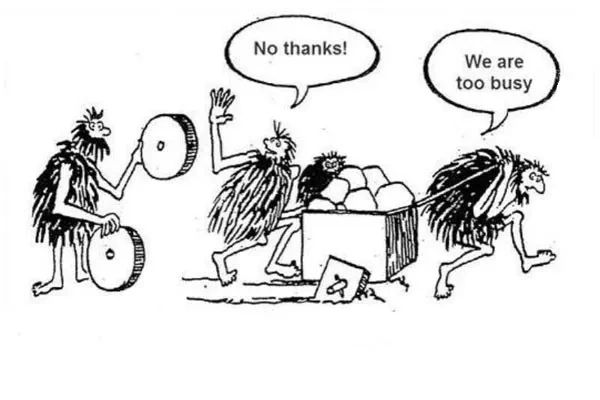
“My inbox is a nightmare.” “Copilot is pretty handy these days at solving inboxes.” “I know. But I’m too busy.”
A genuine conversation and not an uncommon one. I keep hearing similar refrains from senior leaders running businesses that are not “tech first.” Logistics, professional services, retailers, manufacturers. The businesses that are the heartland of the economy. When the conversation turns to AI, the responses are honest and revealing. And they are becoming more expensive by the month.
“I’m too busy” is what leadership disengagement from AI sounds like. But the phrase covers more ground. Sometimes it means a leader tried Copilot months ago, did not find it instantly useful, and moved on. Sometimes it means nobody has shown them what AI looks like on their actual work, so the value remains a mystery, or they are simply cynical that any value will present itself at all. Sometimes it means the technology feels unfamiliar enough that deferring is more comfortable than engaging. And sometimes it simply means that every day is already full, and one more thing to learn is always one task too many. Someone in the team can work it out.
Each of these is a reasonable response to genuine pressure. None of them is a fixed position. But each one has the same effect: the gap between what the leader knows and what their own teams and competitors are already doing is widening. And the leader cannot see it widening, because they are not close enough to the work to notice.
That last point is the one worth sitting with. This is not about keeping up with technology for its own sake. It is about the ability to lead a business that is already changing around you. In many organisations, the people closest to AI are the most junior. The people with the least direct experience of the tools are the ones making decisions about investment, hiring, and strategic direction. That inversion creates a specific kind of risk: decisions being made with confidence but without currency.
An NBER study of nearly 6,000 senior executives across four countries found that the average executive uses AI for 1.5 hours per week. The most common answer was less than one hour. A quarter reported no use at all. This is central bank grade research applied to executive behaviour, and the picture it paints is consistent with what I am seeing in conversations every week.¹
An hour and a half a week is enough to check a draft or ask a question. It is not enough to understand what the tools can do to the shape of your work, your team, or your business. And while leadership steps back, the organisation does not stand still. Teams find their own tools. Individuals solve their own problems. Pockets of capability develop without coordination, without shared learning, and without anyone at the top understanding what is happening or why.
BCG’s research explains why this matters at scale. Their analysis found that leadership teams deeply engaged with AI are twelve times more likely to be among the top five percent of companies generating value from it. Twelve times. When the senior layer engages, the organisation moves with direction. When it does not, the organisation still moves. It just fragments. But that is a different conversation.²
For now, the question is a personal one. The fastest way to close the gap is to use AI on something real. A problem you are currently working on, with the context and constraints you would normally carry yourself. Why not tackle your inbox? Your daily schedule? Something that moves the needle quickly, demonstrates how to free up time, and gives you a reason to learn more. And if you need help getting started, reach out. I can show you how.
¹ Yotzov, I., Barrero, J.M., Bloom, N. et al. (2026). “Firm Data on AI.” NBER Working Paper No. 34836. Survey of nearly 6,000 senior executives across the US, UK, Germany, and Australia, commissioned by the Federal Reserve Bank of Atlanta, the Bank of England, and the Deutsche Bundesbank.
² BCG AI Radar 2026: “As AI Investments Surge, CEOs Take the Lead.” Survey of 2,360 executives across 16 markets, including 640 CEOs. The 12x finding originally reported in BCG, “The Widening AI Gap” (September 2025).